What Norid requires of you when you register a .no domain
Organisations in the Central Coordinating Register for Legal Entities, and people over 18 with a Norwegian national identity number, can register a .no domain if they have a Norwegian postal address. You sign Norid's self-declaration, keep your details correct, and need two working nameservers.
Publisert 20. september 2026
Les denne på norskNorid runs the register for .no. In short, this is what it requires of you:
| Organisation | Private individual | |
|---|---|---|
| Who can register | Registered in the Central Coordinating Register for Legal Entities, with an organisation type Norid accepts | Over 18 and registered in the National Population Register with a Norwegian national identity number |
| Address | Norwegian postal address | Norwegian postal address |
| What you provide | The organisation number | A personal ID from Norid |
| Domains directly under .no | Up to 100 | Up to 5 |
Norid's rules are in the Domain name policy for .no (Regelverk for norske domenenavn). The Norwegian version is the binding one; Norid's English translation says so itself. Under the policy, what you get is a right of use (bruksrett), not ownership. It lasts as long as you renew the subscription, one year at a time. That is why Norid and Sedes call whoever has the domain the subscriber (abonnent): the subscriber is whoever has the right to use the domain. The screenshots in this guide show Sedes in Norwegian. If you use Sedes in English (the language switch in the menu), the labels are the ones in brackets.
Who can register a .no domain?
An organisation must be registered in the Central Coordinating Register for Legal Entities (Enhetsregisteret) with one of the organisation types Norid accepts. The list covers the usual types: limited company (aksjeselskap, AS), sole proprietorship (enkeltpersonforetak), general partnerships (ANS and DA), association or club (forening or lag), foundation (stiftelse), housing cooperative (borettslag), owners' association for a jointly owned building (eierseksjonssameie) and cooperative (samvirkeforetak), and several others. The organisation must have a Norwegian postal address and actually operate as described in the Central Coordinating Register. Norid can ask for documentation that it exists.
A private individual must be over 18, be registered in the National Population Register (Folkeregisteret) with a Norwegian national identity number (fødselsnummer) and have a Norwegian postal address. If you move abroad and are registered as emigrated (utvandret) in the National Population Register, you can keep the domains you have and register new ones, as long as you still have a Norwegian postal address registered with Norid. Norid says so in its FAQ (in Norwegian).
Norid links the domain to the subscriber's organisation number or national identity number, and that number decides who has the right of use. If the domain is for your company, it is simplest to have the company as the subscriber from the start. A sole proprietorship has its own organisation number and can be the subscriber. Moving the domain from yourself to your company later is a change of subscriber, covered further down.
If an agency or someone you know registers the domain for you, the right of use belongs to whoever is listed as the subscriber. Norid says the subscriber is always the one who has responsibility for and control of the domain, and who can end the subscription or transfer it to others. You can see who is listed as the subscriber in Norid's domain lookup.
Can I register a .no domain if I'm not Norwegian?
Yes, if you meet the same requirements as everyone else. Norid's requirements say nothing about citizenship. As a private individual you must be over 18, be registered in the National Population Register with a Norwegian national identity number, and have a Norwegian postal address. If you run a business that is registered in the Central Coordinating Register for Legal Entities, the business can be the subscriber with its organisation number.
What is a personal ID, and how do I get one?
As a private individual you need a personal ID (person-ID) from Norid. Norid uses your national identity number to confirm who you are. Instead of handing out your national identity number, you use a personal ID, both when you order and when you later change anything on the subscription.
You create it with Norid at pid.norid.no before you order. Norid says you get the ID by email within an hour. At Sedes, you choose Privatperson (Private individual) in the Identitet (Identity) step and enter your personal ID there.
If you are ordering for an organisation, you don't need a personal ID. You choose Organisasjon eller firma (Organisation or company) and look up the organisation number, and the name and address are fetched from the Central Coordinating Register for Legal Entities in Brønnøysund.
If you haven't chosen a domain yet, you can find an available .no domain at Sedes.
How many .no domains can I have?
A private individual can have up to 5 domains directly under .no, in the form name.no, and an organisation up to 100. The limits are in section 5 of Norid's Domain name policy for .no, last changed on 12 August 2025.
Norid makes no exceptions to the limits. If you have used up your quota, you must delete a domain before you can order a new one.
On top of that quota, individuals and organisations can each have up to 5 domains under each geographic domain they belong to. These are the domains Norid runs for municipalities, counties and urban areas with more than 5,000 inhabitants. A private individual can also have 5 under priv.no, and an organisation 5 under each category domain it belongs to, such as idrett.no for sports organisations.
What does the self-declaration commit me to?
The self-declaration (egenerklæring) and the subscription terms together make up the contract between you and Norid. The declaration itself is a short version. The full terms are in the domain name policy.
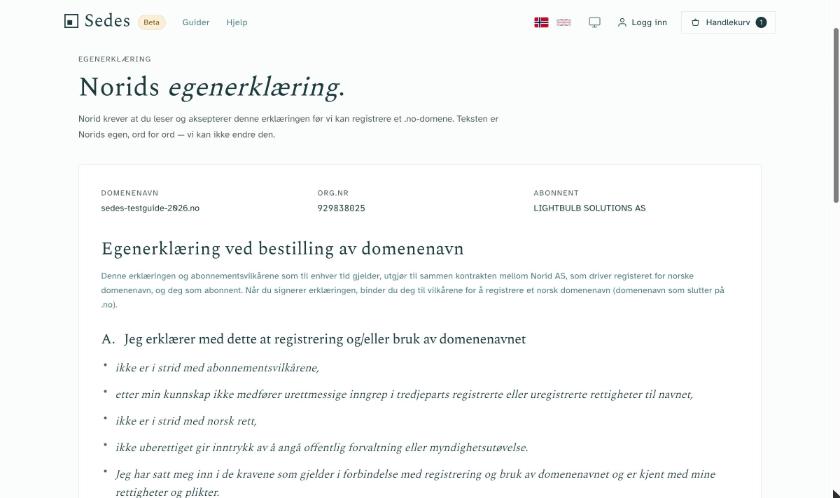
You declare that registering and using the domain
- does not conflict with the subscription terms
- to the best of your knowledge does not infringe other people's rights to the name, whether those rights are registered or not
- does not break Norwegian law
- does not wrongly give the impression of being connected with public administration or the exercise of public authority.
You confirm that you have read up on the requirements that apply and know your rights and obligations.
You also confirm you understand that
- Norid shows information about you as the subscriber in a public lookup, but that you can give an anonymised email address as long as it reaches you
- complaints about your registration can be heard by the Alternative Dispute Resolution Committee (Domeneklagenemnda), that you are bound by its decision, and that you pay the complaint fee if the complainant wins
- Norid can withdraw the domain when it is obvious that the registration conflicts with the declaration or the terms.
Finally, you commit to following the terms as they stand at any time, and to keeping yourself up to date on changes. The subscription must be renewed every year, and each time it is renewed, you accept the terms in force at that time.
In practice, the second point, about other people's rights, matters most. Norid does not check whether the name you want infringes anyone's rights. That is your responsibility, and you bear it in full, including liability for damages and criminal liability. Rights can be a registered trademark or a business name, but also a name that is protected because it has been in use for a long time. Norid itself points to navnesok.no, which searches the domain register, the Central Coordinating Register for Legal Entities and the trademark register in one go. Search there before you order.
At Sedes, the whole declaration is shown word for word in the Egenerklæring (Self-declaration) step, with the domain and the subscriber at the top.
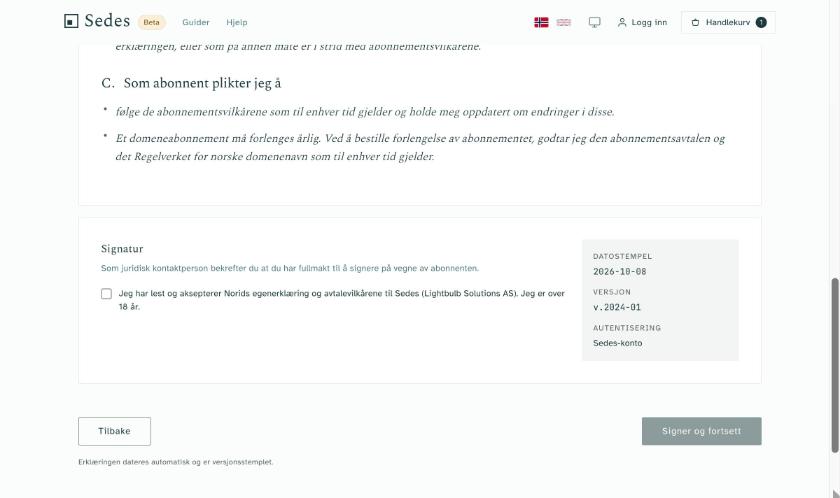
Below the declaration, you sign by ticking the box and clicking Signer og fortsett (Sign and continue). The declaration is dated automatically and stamped with its version. If you are ordering for an organisation, you also confirm that you are authorised to sign on its behalf.
In the Abonnent (Subscriber) step before the declaration, you can choose to hide your email address in WHOIS, the public lookup. The option is ticked in advance.
What happens if my details are wrong?
The details you give must be correct when you apply and for as long as you hold the domain. Norid can ask you to confirm that they are still correct, and you must then be able to document them. You must also keep your contact details and technical details up to date. If something has changed for a domain you have at Sedes, email hei@sedes.no and we will report the change to Norid.
Your email address matters most. That is where Norid sends notices when something is wrong with the subscription, for example that it has not been renewed. If the notice doesn't reach you, in the worst case the subscription can be ended and the domain deleted.
There are three ways a domain that was registered improperly can be taken away.
Can Norid delete my domain?
Yes, if the registration is based on incorrect information from you or from someone who applied on your behalf. An unsigned self-declaration counts as incorrect information. You get the chance to respond before the domain is deleted, and the notice comes by email at least 60 days in advance. Norid can also delete a domain when it cannot reach the subscriber's contact person, when the organisation has been removed from the Central Coordinating Register for Legal Entities, or when the domain does not meet the technical requirements.
Can Norid or Nkom take my domain to the Alternative Dispute Resolution Committee?
Yes. The Alternative Dispute Resolution Committee (Domeneklagenemnda) is an independent body for domain disputes that can be settled quickly. Norid acts as the committee's secretariat and carries out its decisions. Norid can bring a complaint against a domain because it was registered in breach of the self-declaration, and the committee can decide that it is to be deleted. The Norwegian Communications Authority (Nasjonal kommunikasjonsmyndighet, Nkom) can complain in the same way when a domain has been registered in breach of the Norwegian Domain Regulations (domeneforskriften).
Can a trademark owner take my domain from me?
They can complain to the Alternative Dispute Resolution Committee if they have a right to a name or mark that is the same as your domain or could be confused with it, for example through a trademark or a business name. The deadline is three years from when the domain was registered. The complainant must show that it has a right to the name, and that you registered or used the domain in bad faith, meaning that you knew or should have known it could infringe the complainant's rights. The committee can decide that the domain is to be deleted or transferred to the complainant. While the case is ongoing, the domain can be neither transferred nor deleted.
The complainant pays a complaint fee before the case is heard. If the complainant wins, you have to cover the fee. The current amount is on Norid's page on complaints. The committee's decision cannot be appealed, but either party can take the case to the courts afterwards.
If you get a notice from Norid or a complaint about a domain you have at Sedes, email hei@sedes.no.
What does Norid require of the nameservers?
Nameservers are the machines that answer questions about your domain, such as which address your website is at. Norid only registers a domain when at least two nameservers are set up correctly for it and are working at the moment the application arrives. Norid checks the requirements at registration and regularly after that. A breach can mean the application is rejected or the domain is deleted.
The requirements are in Appendix F to the domain name policy:
- The domain must have at least two nameservers, on physically separate machines.
- The nameservers must answer authoritatively for the domain, that is, as the actual source of the information about it.
- The nameservers must themselves list exactly the same nameservers as the application, with the same names and the same number.
- They must be connected to the internet at all times and have a fixed IPv4 address. They can have IPv6 as well.
- The SOA record, which holds the basic information about the domain, must have a working email address for whoever runs the nameservers, and the same serial number on all of them.
- NS records must point to the real name of a nameserver, never to an alias (CNAME).
DNSSEC, a signature that protects against false answers, is optional.
You don't need to run the nameservers yourself. A domain at Sedes uses ns1.sedes.no to ns4.sedes.no from the moment it is registered. What the nameservers and the records on them do is explained in Your domain's DNS settings, explained.
The requirements start to matter to you the day you switch to nameservers at another provider. Norid checks the new nameservers before the change goes through, so your domain must be set up at the new provider before you switch. If the switch doesn't go through, email hei@sedes.no.
What is the difference between changing registrar and changing subscriber?
A registrar (domeneforhandler) is a company that has an agreement with Norid and orders the domain and manages the subscription on your behalf. Sedes is one of them. Norid does not accept payment directly from you. You pay the registrar.
Changing registrar changes who manages the subscription. Changing subscriber changes who has the right of use.
How do I change registrar?
You can change registrar at any time and keep your domain and subscription. You need one of two codes, and Norid treats them the same:
- a transfer code (flyttekode), which you get from your current registrar
- a one-time token (engangskode), which the new registrar orders, and which Norid sends to the email address on the subscription. You can see which address that is in the domain lookup.
The codes are there so that nobody can move your domain without you having asked for it. Norid does not charge the registrar for a transfer, and your old registrar cannot charge you for giving you the transfer code or for updating your email address so that you can receive a one-time token (Norid on changing registrar).
At Sedes you move the domain with the transfer code: in the order, paste it into the field called Autorisasjonskode (Authorisation code). Ask your current registrar for the code; they cannot charge you for it. If you can't get it, email hei@sedes.no.
How do I transfer my domain to my company or a buyer?
That is a change of subscriber (abonnentskifte): the domain passes to someone else, for example from you to your limited company, from a sole proprietorship to a limited company, or to a buyer. Norid then ends the old subscription and creates a new one for the new subscriber. For this, the new subscriber must meet the requirements for having a .no domain, the subscription must not have expired, and both the current and the new subscriber must approve the transfer.
The transfer goes through a registrar, and Norid sends the subscriber a confirmation by email once it is done.
The new subscription gets a new registration date. That means the three-year deadline for complaints to the Alternative Dispute Resolution Committee also starts again. So if you buy a domain from someone, a complaint about the name can be filed for three years from the day you took it over.
If you want to change the subscriber of a domain you have at Sedes, email hei@sedes.no.
Sources: Norid's Regelverk for norske domenenavn (last changed 12 August 2025) with appendices E, F, G, H, J and L, and Norid's pages Hvem kan abonnere på et norsk domenenavn?, Ofte stilte spørsmål, Lag person-ID, Hvordan oppdatere kontaktinformasjon, Klage på domenenavn, Hvordan bytte forhandler, Hvordan overføre domenenavnet til en ny abonnent and Domenenavnsystemets rolle i tjenesteproduksjon, all in Norwegian and read 8 October 2026. The English links in the text go to Norid's English translations of the same pages, checked the same day; where the two differ, the Norwegian text applies. The screenshots are from an order at Sedes the same day.